
At booost technologies, we offer "booost GX," a management system for calculating and reducing CO2 emissions, and "booost Supplier," which enables visualization and reduction of CO2 emissions in the supply chain and sharing of ESG data!
You can download detailed information here!
● Service introduction materials for "booost GX"
With the increasing business risks posed by climate change, developing business strategies that anticipate the impacts of climate change has become a crucial issue for companies. As one way to address this, you may have noticed the abbreviation "TCFD" becoming more common.
What is TCFD?
TCFD stands for the Task Force on Climate-related Financial Disclosures, which was established in 2015, primarily by the Financial Stability Board (FSB).
source:TCFD (Task Force on Climate-related Financial Disclosures) Recommendations (Final Report) (English)
In 2017, the TCFD published its recommendations to financial institutions and corporations regarding a framework for voluntary disclosure of climate-related financial information. Its main objective is to create a consistent framework for climate-related financial disclosures, enabling investors to properly understand organizations' significant risks and opportunities. It also encourages organizations to disclose their efforts toward climate change and to promote responsible commitment and action.
source:Guidance on Climate-related Financial Disclosures 3.0 (TCFD Guidance 3.0)
Scope and disclosure items of TCFD recommendations
The TCFD recommendations apply not only to all entities that issue bonds or stocks, but also to public and private pension funds and foundations.
In Japan, the Corporate Governance Code revised by the Tokyo Stock Exchange in June 2021 mandates that companies listed on the Prime Market disclose information in accordance with the TCFD recommendations or an equivalent international framework.
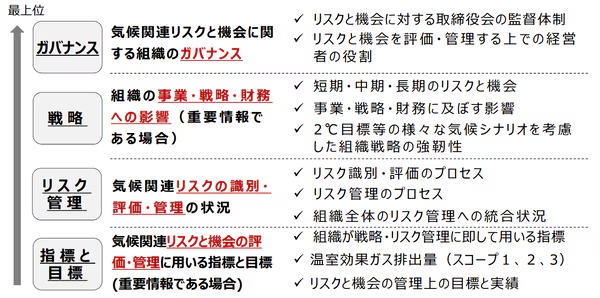
The TCFD recommendations encourage companies to identify the risks and opportunities of climate change that affect their business activities, as shown in the diagram below.The four disclosure items are "Governance," "Strategy," "Risk Management," and "Metrics and Targets."Information disclosure within this framework is required.
An appendix (sector-specific supplementary document) has also been prepared, providing sector-specific explanations for the financial sector and non-financial industries that are most likely to be affected by climate change and the transition to a low-carbon society.
Furthermore, to supplement the TCFD recommendations, guidance has also been published on scenario analysis, risk management, and indicators, targets, and transition plans.
Source: Guidance on Climate-related Financial Disclosures 3.0 (TCFD Guidance 3.0)
Benefits of supporting the TCFD
As of September 22, 2022, 3,819 companies and organizations worldwide have expressed their support for the TCFD. Japan has the highest number of supporters, with 1,062 companies and organizations.
So, what are the benefits of supporting the TCFD?
- This will increase investment opportunities for investors.
- In recent years, ESG investing, which involves investing in companies that prioritize environmental and social factors, has gained attention. Companies recognizing, managing, and disclosing climate-related risks and opportunities demonstrates their commitment to ESG management. This can lead to increased investor trust and is expected to result in increased investment from financial institutions.
- By disclosing information on climate-related risks and opportunities in line with the TCFD recommendations alongside regular financial reporting, companies can meet existing disclosure requirements and produce higher-quality financial reports.
- Disclosing information in line with the TCFD recommendations deepens our understanding of climate-related risks and opportunities and enhances our knowledge. As a result, it becomes possible to strengthen management and develop informed strategies.
- The TCFD recommendations suggest that by utilizing scenario analysis, companies may be able to discover new business opportunities and needs they hadn't anticipated, and develop strategies accordingly.
source:Ministry of Economy, Trade and Industry: Japanese Companies and Organizations that Support TCFD
source:Ministry of the Environment, "Summary of the Task Force on Climate-related Financial Disclosures (TCFD)"
The future importance of TCFD
The global ESG investment market is growing and is expected to continue expanding. At the same time, the disclosure of climate change information is becoming increasingly important, and the TCFD recommendations are becoming a global standard.
In Japan, as mentioned earlier, not only have companies listed on the Prime Market been made obligated to disclose climate change information based on TCFD recommendations or equivalent international frameworks, but the Financial Services Agency has also decided to require companies to disclose sustainability information, including climate change, in their securities reports.
Disclosures based on the TCFD recommendations are also being required overseas. In November 2021, the IFRS Foundation, which sets international accounting standards, established the International Sustainability Standards Board (ISSB). The ISSB plans to publish new information disclosure standards based on the disclosure items of the TCFD recommendations by the end of 2022. If the ISSB standards are developed with the goal of providing internationally consistent disclosures that are useful for investment decisions, it is highly likely that companies will be required to transition from the TCFD recommendations to the ISSB standards in the future.
source:Financial Services Agency Disclosure Working Group Report (Draft)
summary
As mentioned above, the dissemination of TCFD recommendations and the utilization of other information disclosure frameworks and evaluation organizations are steadily progressing. As ESG management gains more attention in the future, efforts toward TCFD recommendations will become increasingly important.
booost technologies Inc. is promoting decarbonization by offering a carbon management cloud that enables the automatic calculation, visualization, management, and reporting of CO2 and other emissions.booost GXWe will provide support for the implementation of [the program] and, as a CDP scoring partner, support the disclosure of information on international climate change frameworks, including TCFD. We encourage you to take this opportunity to deepen your understanding of TCFD and consider supporting it.