Sustainability Information Management Tools Market (by Sales Volume) - Annual Sales of 500 billion yen or more: Vendor-specific sales revenue share (FY2024 forecast)
Sustainability Information Disclosure
Common misconceptions
The scope of data collection is It can be decided by the company.
Previously, the scope of data collection for integrated reports and other documents was optional,Going forward, data collection will be required to be limited to the same scope as financial reporting.
Non-financial disclosures are derived from financial disclosures.
It can be disclosed later.
Traditionally, the timing of disclosure was at the discretion of the company, and it was common for it to be delayed by 2-3 months compared to financial disclosures.Going forward, simultaneous disclosure of financial and non-financial information will be required.
Regulatory compliance
The deadline is still far away.
While the Omnibus Regulation revised some European regulations, there were no changes to the timing of application for non-EU companies.Japanese companies are required to respond according to the usual deadlines.
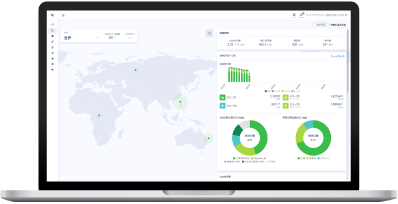
Global consolidation, capable of handling hundreds of companies or more. Supports 25 languages.
Our sustainability ERP system has a proven track record, being used in over 192,000 locations across 92 countries. With an interface supporting 25 languages, it enables centralized management of sustainability data worldwide.
We provide reliable support backed by robust security adopted by major corporations and extensive expertise based on multiple patents.
By implementing IT controls,
Group linkage improves work efficiency and accuracy.
Automate complex, globally dispersed data collection processes and support major frameworks such as SSBJ, ISSB, and CSRD/ESRS. Real-time SX status monitoring and features to meet up to 15 levels of organizational configuration and audit requirements improve efficiency and accuracy.
Examples of functions that meet audit requirements Approval flow, permission settings, evidence attachment, threshold errors, reasons for discrepancies, year-on-year comparison.
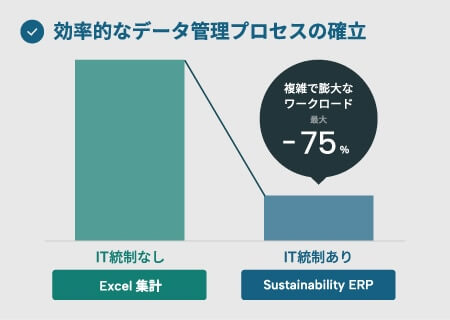
Reduce workload by up to 75%
We automated the data collection process, which previously took a year, significantly reducing man-hours. This can be achieved quickly by utilizing standard processes.
We will eliminate the need for extensive email correspondence and reminder tasks, and establish a system that enables simultaneous disclosure of financial and non-financial information.
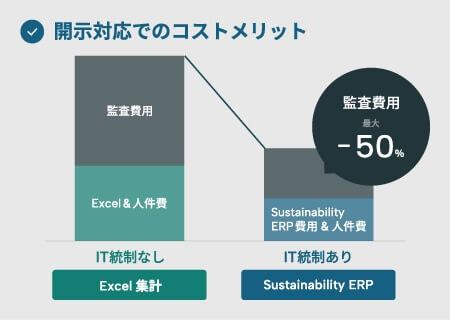
Third-party guarantee costs to be reduced by up to 50%
Responding to SSBJ and CSRD requires preparation that anticipates future regulatory guarantees. Limited and reasonable assurances of non-financial information require assurance costs equivalent to those of financial information.
Sustainability ERP significantly reduces the costs associated with obtaining assurance by enabling effective IT controls and reducing the workload of audit firms.
Covers all core sustainability operations of the group.
Global IT Controls
Control over approval flows and permission settings
Automatic generation of 15-tier approval flow
Real-time monitoring
Global SX Platform
Support for global activity bases
Global permission settings
Global Approval Workflow
Global Organization Master
Guaranteeing data accuracy
Attached evidence
Automatic error alert function
Explanation of the reason for the difference
ESG Management
E: Collection/management of general environmental data
S: Social data collection/management
G: Collection/management of governance data
GHG Management
Carbon Accounting Automatic Journal Entry Function
Calculation of Scope 1, 2, and 3
Emissions factors (IDEA, IEA, ecoinvent, etc.)
Reduction Roadmap
Energy Management
Visualization of energy data (EMS)
Visualization of Energy Saving Potential (EFM)
Renewable energy procurement and supply (RES)
PPA management function
Power Supply Management
Environmental Due Diligence
Human Rights Due Diligence
GHG primary data collection and calculation
PACT Methodology (cumulative approach)
Supplier Communication
Product Carbon Footprint
Product-level carbon footprint calculation
Method is a separate calculation function.
BOM integration, actual measurement calculation
Cumulative calculation (material and parts processing)
Uranus Ecosystem Features
Form Template
CSRD/ESRS Data Point Template
IFRS/ISSB Data Point Template
SSBJ Data Point Template
Other
Disclosure Module
Creation of quantitative control items
Creation of qualitative management items
Disclosure aggregation tag function
User management function
XBRL
Create and output taxonomy files.
XBRL Multi-Reporting Function
Benchmark comparison feature
Audit Account
Third-party warranty account function
Audit efficiency features
Warranty efficiency
Data Download
Analysis Module
Drill-down analysis function
Real-time monitoring and analysis functions
Organization/department/business/region/location analysis function
Aggregation/Analysis/Export Function
Centralized management of input progress for each consolidated company within the group.
Financial Impact
Calculating financial impact in the short, medium, and long term.
Creation/management of various quantitative formulas
Impact calculation based on IRO
Proposal for quantifying qualitative data
Covers SSBJ-compliant business workflows.
The SSBJ compliance workflow is as follows: preparation → data collection → financial impact assessment → disclosure content creation → audit → management analysis. We need to address these 10 key points comprehensively.
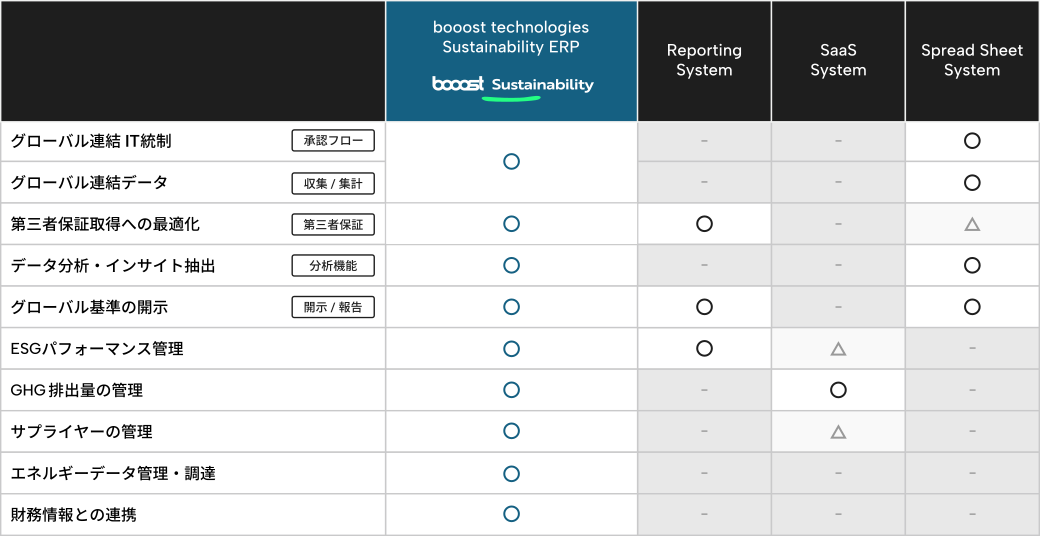
ESG software comparison table
Itochu Corporation
Sustainability leader with No. 1 ESG score adopts Boost as a consolidated sustainability platform for 600 global locations
assignment
The process of collecting sustainability-related data from approximately 600 locations was incredibly time-consuming, and the "bucket brigade" method using Excel and email made version control cumbersome. This situation made it difficult to allocate sufficient resources to data analysis and strategy development, and the increasing demand for disclosure of non-financial information made it challenging to keep up with the demands using traditional methods.
Reasons for introduction
Providing best practices for how business should be done
Flexible customization to suit our needs
Supported by a consulting team with specialized knowledge of SX
It has the ability to be expanded to cover non-financial information in general, including human capital, which will be needed in the future.
AEON Co., Ltd.
Aeon, one of Japan's largest retailers, will make this a reality.
Building a foundation for sustainable business operations
assignment
Aeon, which has over 300 group companies and more than 20,000 stores, faced the challenge of requiring a tremendous amount of effort to calculate CO2 emissions for each store, implement business continuity plans (BCPs), and manage the progress of energy conservation and renewable energy projects. Furthermore, obtaining supplier data for SCOPE3 calculations was also a significant burden.
effect
By introducing "Sustainability ERP," each group location was given an account, significantly reducing the amount of work required for consolidation and management at headquarters.
We updated the global infrastructure of our 300 group companies and achieved IT controls that can withstand SSBJ regulations.
Nippon Ham Co., Ltd.
Nippon Ham's initiative
Efficiency improvement of sustainability data collection
Reasons for introduction
Aiming to realize a sustainable society, we have identified "contributing to a sustainable global environment" as one of our material issues. We are focusing on "responding to climate change," including reducing CO2 emissions from fossil fuels and controlling greenhouse gas emissions from livestock. To further promote these efforts and to achieve consistent management and clarity of reduction actions on the cloud, we have introduced "booost Sustainability."
We standardize best practices for "non-financial information management" in global companies. Flexible implementation tailored to each company's objectives, such as compliance with CSRD and ISSB, and enhancing corporate value, enables the streamlining and optimization of sustainability-related operations.