
An integrated report is a report that combines financial information related to performance, such as sales and profits, with non-financial information disclosed in CSR reports, ESG reports, etc.
This article will explain what an integrated report is, its purpose, and what kind of information is required to be reported in an integrated report.
The archived video of the seminar explaining the new sustainability disclosure standards and outlining what companies should do now to ensure proper disclosure is available here.
What is an integrated report?
An integrated report is a report that compiles legally required financial information, such as a company's business overview and policies, as well as non-financial information such as corporate governance and social responsibility, and explains the company's value creation strategy. In Europe and the United States, it is becoming widespread as an annual report, and although there is no obligation to issue an integrated report in Japan, the number of companies adopting it has been rapidly increasing in recent years.
Furthermore, integrated reports systematically explain management practices and also summarize corporate operations, including non-financial information (CSR, ESG, etc.). Therefore, they serve as a tool for disseminating information not only to investors but also to stakeholders such as customers and employees. For this reason, using integrated reports as a means of communicating with society can be extremely beneficial for corporate branding and other aspects.
This kind of information dissemination can also help with fundraising through ESG finance, such as Sustainability-Linked Loans (SLLs).
Purpose of the Integrated Report
The integrated report highlights the goal of realizing a sustainable society.
In recent years, with the rise of ESG investing, there has been an increasing demand for the disclosure of ESG information, including not only financial information but also environmental, social, and governance information. As a result, integrated reports have become a communication tool for companies to shareholder (investors) and stakeholders (employees, customers, etc.), and a means of showcasing their efforts toward CSR (corporate social responsibility) and the realization of a sustainable society.
The purpose of an integrated report is not only to disclose management strategies and policies (shareholders), but also to correct information gaps and improve credibility (stakeholders), which are important points.
Visualizing intangible assets and correcting the corporate information gap
In today's increasingly knowledge-based economy, the importance of addressing and visualizing intangible assets, in addition to tangible assets, is growing globally.
In financial markets, the efficiency of stock prices is considered to be not that of strong-form stock prices, where all information is reflected, but rather that of semi-strong-form stock prices, where only some information is reflected. While tangible assets are reported in financial statements, intangible assets and integrated management strategies are not. Therefore, by using integrated reports to communicate this information both domestically and internationally, it is thought that this information will be more easily reflected in stock prices.
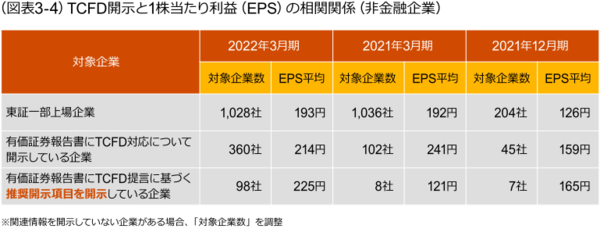
For example, a PwC study showed that, regarding the relationship between TCFD disclosure and earnings per share (EPS), companies that disclose their TCFD efforts have, on average, higher EPS than companies that do not.
What are the required elements of an integrated report?
The integrated report includes eight content elements. Each content element is inherently interrelated and not mutually exclusive.
- Organizational Overview and External EnvironmentWhat does the organization do, and in what environment does the organization conduct its business?
- GovernanceHow does an organization's governance structure support its short-, medium-, and long-term value creation capabilities?
- Business ModelWhat is the organization's business model?
- Risks and opportunitiesWhat are the specific risks and opportunities that affect the organization's short-, medium-, and long-term value creation capabilities, and what measures is the organization taking to address them?
- Strategy and resource allocationWhere does the organization aim to go, and how will it get there?
- AchievementsTo what extent did the organization achieve its strategic objectives during the period in question, and what were the outcomes in terms of impact on capital?
- OutlookWhat challenges and uncertainties is the organization likely to face in executing its strategy, and what are the potential impacts on its business model and future performance as a result?
- Fundamentals of creation and displayHow does the organization determine the events to include in its integrated report, and how are those events quantified or evaluated?
source:Japanese translation of the International Integrated Reporting Framework
summary
As mentioned earlier, including non-financial information, especially ESG information, in integrated reports has become extremely important. Including ESG information in integrated reports allows companies to: ① promote their commitment to a sustainable society through the report, and ② visualize intangible assets and correct information gaps within the company, thereby contributing to increased corporate value.
However, since this document explains a strategy for value creation, it should not simply link financial and non-financial information, but rather strategically present a narrative of what kind of value will be created in the short, medium, and long term using those assets, and how.
Based on the above perspectives, booost technologies Inc. provides support for creating IFRS-based integrated reports aimed at improving corporate value, calculation of Enterprise Value, consulting for ESG visualization and TCFD disclosure and quantification, and a decarbonization support platform that enables automatic visualization of CO2 emissions and carbon offsetting.booost GXWe offer "[this service]".
Reference seminar:Current climate change disclosure responses
If you are having trouble creating an integrated report, please feel free to contact us using the information below.