
In line with the long-term goals set out in the Paris Agreement, governments and companies around the world have recently declared their commitment to carbon neutrality. The Japanese government's "Green Growth Strategy in conjunction with Carbon Neutrality by 2050" is based on the premise of reducing absolute emissions in order to reduce domestic carbon emissions.
Furthermore, attention is being drawn to the use of carbon credits as an effective tool for achieving carbon neutrality. It is expected that the revitalization of carbon credit trading will accelerate efforts to reduce emissions, and as an example, in Japan, a pilot project for carbon credit (J-credit) trading began at the Tokyo Stock Exchange on September 22, 2022.
This article provides basic information about carbon credits.
At booost technologies, we offer "booost GX," a management system for calculating and reducing CO2 emissions, and "booost Supplier," which enables visualization and reduction of CO2 emissions in the supply chain and sharing of ESG data!
You can download detailed information here!
● Service introduction materials for "booost GX"
What are carbon credits?
Carbon credits are a form of quantification and tradable representation of greenhouse gas reductions and absorptions achieved through the introduction of renewable energy sources (such as solar and wind power), the installation of energy-efficient equipment (reduction projects), or forest management such as afforestation and thinning (absorption projects), based on a defined methodology.
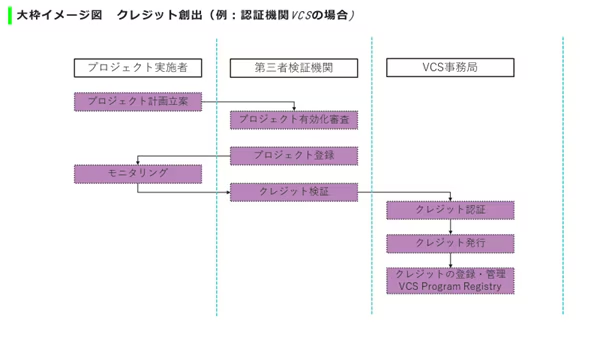
Credits are managed in an electronic system called a registry, where 1 ton of CO2 equals 1 unit. With some exceptions, in most cases, credits are issued to an account managed by a certification body only after the project's usefulness has been verified and certified by the certification body.
Below is an example of the certification flow using VCS (Verified Carbon Standard), a private certification credit managed by the US non-profit organization "Verra," a global certification body.
Types of credits and voluntary credits that are attracting attention
There are two types of carbon credits: those issued under government initiative (compliance market-derived credits) and those issued under private initiative (voluntary credits). Furthermore, there are many categories depending on the method of CO2 reduction, and the systems and uses in which they can be utilized differ depending on the type of credit.
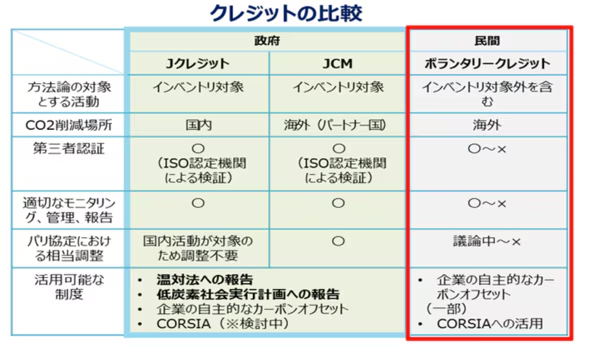
Source: Ministry of Economy, Trade and IndustrySummary of the Interim Report of the Study Group on Economic Methods and Other Approaches for Achieving Global Carbon NeutralityExcerpted from and partially modified from "[source]".
Credits can be broadly categorized into avoidance/removal systems and stationary absorption systems, as described below. Recently, stationary absorption credits have been highly valued for reasons such as offsetting emissions from industrial sectors that are difficult to reduce.
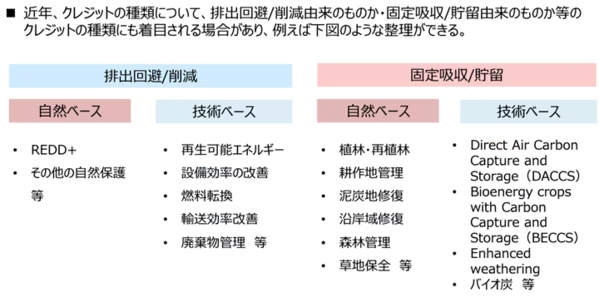
source:TSVCM Final Report (January 2021)Created from
How to utilize carbon credits
The main uses include carbon offsetting and reporting to initiatives. It is important to note that depending on the characteristics of the credit, it may or may not be usable. For example, J-Credits can be used for carbon offsetting and reporting in CDP, SBT, and RE100. However, while voluntary credits can currently be used for companies' voluntary carbon offsetting, reporting the figures after offsetting with credits in reports such as CDP is generally not permitted. However, it is possible to report them in CORSIA, an initiative in international aviation.
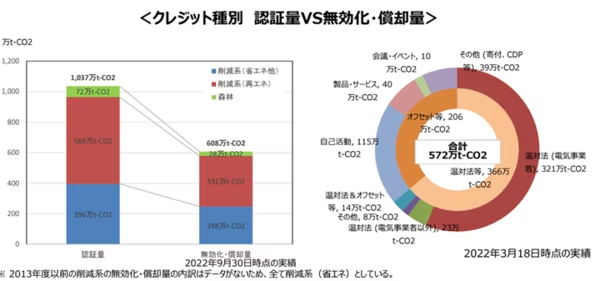
source:Latest data from the J-Credit Scheme Secretariat
summary
While the use of carbon credits can be an effective tool for companies aiming for carbon neutrality, the current situation in Japan is that the amount issued is still small, and there are not many consumers who are able to utilize them effectively.
One reason for this is that the credit system is underdeveloped, making it difficult to use credits. In Japan, a pilot project for the J-Credit trading market has begun, and improvements in system development and ease of use are expected. In order to build a society that can easily achieve carbon neutrality, improvements in the system and the creation of a trading market for voluntary credits are also expected to improve convenience.
At booost technologies Inc., we offer comprehensive sustainability consulting services to enhance corporate value, including support for ESG, TCFD, human capital improvement, and the creation of IFRS sustainability integrated reports and annual reports. We also provide a decarbonization support platform that enables automatic visualization of CO2 emissions and carbon offsetting.booost GXWe offer "[this service]".
If you have any concerns about disclosing sustainability information, please feel free to contact us.