
J-Credits are a system in which the Japanese government certifies the amount of CO2 emissions reduced or absorbed through the introduction of energy-saving equipment, the use of renewable energy, and appropriate forest management as "credits." By utilizing this system, it is possible to use them for various purposes such as legal compliance, reporting to initiatives, and carbon offsetting.
Main Use Cases
- Reporting to the Act on Countermeasures against Global Warming and the Act on Energy Conservation
- Reporting to initiatives such as CDP, SBTi, and CORSIA.
- Achieving the RE100 Goal
- Carbon offset (Example:2023 Tokyo Olympics)
You can download information about our services related to offsetting in general, including the procurement and invalidation of various certificates and credits such as J-Credits, overseas voluntary credits, and domestic and international power certificates, as well as proposals for offsetting that lead to increased added value for your business, from here.
● Service introduction material for "Offset Solutions"
Role of participants in the J-Credit scheme
The roles of participants in the J-Credit scheme are as follows:
| name | role | Specific example |
|---|---|---|
| administrator | Register and authenticate your project. | Ministry of Economy, Trade and Industry, Ministry of the Environment, Ministry of Agriculture, Forestry and Fisheries |
| J-Credit Creators | People who launch projects and generate credit. | Companies, local governments, farmers, etc. |
| J-Credit Provider | Buying and selling agency, depreciation agency | Intermediary |
| J-Credit purchasers | People who buy credits created by the creators | Companies, local governments, etc. |
Benefits for J-Credit users
The benefits for J-Credit users are as follows:
| name | merit |
|---|---|
| J-Credit Creators | Lower running costs through energy conservation and renewable energy; profits from selling credits; PR effect as a company with a strong interest in environmental issues; and the creation of new networks through the buying and selling of credits. |
J-Credit Provider | Commission revenue from brokerage services. |
| J-Credit purchasers | Use of carbon offsetting; PR effect as a company highly interested in environmental issues; improved corporate reputation; creation of new networks through credit trading. |
J-Credit Issuance Procedure
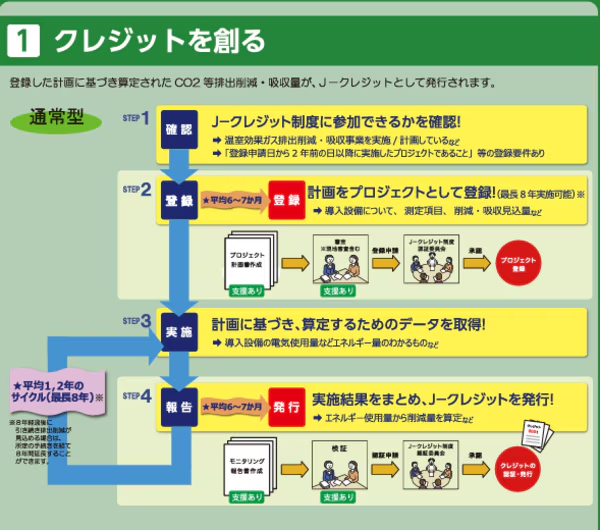
Credit verification/issuance requires project registration and monitoring.
Furthermore, the registration process requires the use of the "J-Credit Registry System," which is the registry for J-Credits, and therefore requires opening an account.
reference:J-Credit System Brochure
Process until issuance
- Project Registration
- Prepare and submit a plan outlining "what CO2 emission reduction/absorption projects (such as the introduction of energy-saving equipment and forest management) will be implemented."
- Approval of the project plan by the reviewing body
- Project registration application, consultation with an expert committee, formal registration by the government.
- monitoring
- Based on the project plan, monitoring and report generation are conducted to calculate emission reductions/absorptions.
- Verification of monitoring reports by review bodies
- Credit authentication and issuance
- After consultation with an expert committee, if certified, the government will issue credits.
As described above, you can issue credits by registering and monitoring projects. However, registering each project individually and paying the above costs when you cannot issue large amounts of credits is cumbersome, so a method called programmatic projects exists to improve this problem.
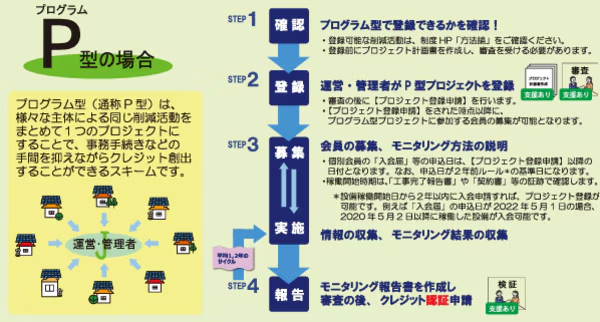
About program-type projects
Program-type projects are a method of generating J-Credits in a lump sum by aggregating small-scale reduction activities. There are "program operators/administrators" and "members," and credits are generated by operators/administrators managing the projects owned by members on their behalf.
reference:J-Credit System Brochure
How to trade J-Credit
There are three main ways to trade J-Credit.
1. Over-the-counter transactions
Over-the-counter (OTC) trading, also known as over-the-counter (OTC) trading, is a method of buying and selling where the parties involved agree on terms such as price and quantity without going through a trading market. While it has the advantage of being unaffected by price fluctuations because it doesn't go through an exchange, it also has drawbacks such as the possibility of price variations depending on the trading partner, and the possibility of transactions being conducted at significantly higher prices than exchange-traded transactions due to information asymmetry. Furthermore, because transaction details are not made public, it is difficult to grasp the full scope of the transaction, resulting in a lack of transparency and fairness compared to exchange-traded transactions.
Currently, this method of transaction is the mainstream for J-Credit.
2. Buying and selling intermediaries by internet service providers, etc.
A J-Credit Provider (hereinafter referred to as "Provider") refers to a business that can support the creation and utilization of credits certified under the J-Credit system, with the aim of promoting the creation and utilization of credits. Registration as a Provider is handled by the J-Credit System Secretariat, and there are three types of Providers.
- Creation and Utilization Support: Supporting the creation and utilization of credits.
- Creation support: Supporting the creation of credits.
- Support for utilization: Supporting the use of credits.
While it is required to meet the J-Credit Provider Standards, it is important to note the disclaimer from the J-Credit System Secretariat, which states, "We do not grant certification or approval to registered businesses, nor do we guarantee their current or future reliability. Furthermore, we assume no responsibility whatsoever for any troubles arising from transactions with registered businesses."
By using an internet service provider (ISP), you don't need to open an account, and you can entrust everything from credit utilization consulting to buying and selling services and depreciation to the ISP.
3. Bidding transactions / Market transactions on the Tokyo Stock Exchange (Pilot experiment ended in January 2023)
The J-Credit Scheme Secretariat previously conducted auction sales, but as of November 16, 2022, it has switched to a policy of selling government-held credits as part of a demonstration project for the carbon credit market.
On the Tokyo Stock Exchange, prices are determined not by order book trading, but by a system called "order book matching" which takes place twice a day. (Prices are determined twice a day.)
There are two types of credits: "renewable energy generation" and "energy conservation, etc."
To participate in the Tokyo Stock Exchange market, you need to register as a "demonstration participant" with the Tokyo Stock Exchange and have a J-Credit account.
| merit | Disadvantages | |
|---|---|---|
| Over-the-counter (OTC) transactions | You can freely set transaction conditions that are less susceptible to credit price fluctuation risk. | Finding a suitable partner is difficult, transactions are opaque, and information asymmetry clearly creates advantages and disadvantages. Some partners have credit lists, and it's necessary to assess the quality of credit. |
| Exchange trading | Transactions are fair and transparent (clearing, etc.), prices are public and clear, and credit quality is guaranteed (filtered by the exchange). | In Japan, the Tokyo Stock Exchange (TSE) just completed a pilot program in January 2023. With low liquidity, prices are not determined, leading to price fluctuation risks. Trading must adhere to the exchange's rules. |
| Buying and selling brokerage | Most companies do not require account opening and also handle operations (transfer, depreciation, etc.) on your behalf. | For businesses that must trade at prices set by intermediaries, it's necessary to assess the quality of the credit. |
Challenges of J-Credits
According to a report by the Ministry of Economy, Trade and Industry, the following challenges exist in expanding the J-Credit scheme:
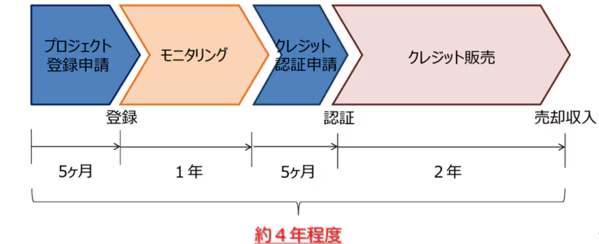
- The procedures required for project registration, such as creating a plan and verifying its validity, are complex (the registration and certification process takes an average of about 5 months).
- The credits created rely on over-the-counter transactions, making it difficult to predict when they will be bought and sold.
- It takes an average of four years from project registration to credit sale.
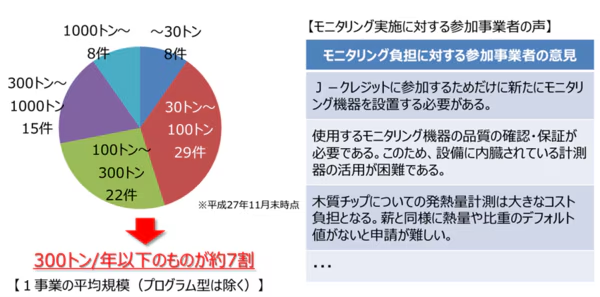
- If it's not a program-based credit, the amount of credit generated per transaction is small and the unit price is not high, so there is little benefit for the creator.
- Monitoring is a heavy burden for small and medium-sized enterprises.
reference:Ministry of Economy, Trade and Industry: Current Status of the J-Credit Scheme
summary
This article provided an overview of J-Credits, including their issuance procedures, trading methods, and challenges.
If you are considering carbon offsetting initiatives or have a strong interest in environmental issues, you might want to use this article as a reference to compare and consider J-Credits.
booost technologies Inc. promotes GX (Green Transformation) through visualization of CO2 emissions, carbon offsetting, and reporting.booost GXWe provide this service and support carbon offsetting initiatives such as the issuance and trading of J-Credits.
Please feel free to contact us using the information below.