
The Carbon Border Adjustment Mechanism (CBAM), one of the carbon pricing measures in the European Union (EU), is attracting attention. A transition period has already begun in 2023 to impose reporting obligations on eligible businesses, with full implementation planned for 2026. Under this measure, importers of eligible products will be required to submit information to the European government quarterly regarding GHG emissions and other data generated from the production of imported products within the EU.
This article explains the overview of CBAM and its impact on Japanese companies. We hope that this article will deepen your understanding of CBAM in order to maintain and improve your competitiveness in the EU market.
You can download the solution documentation here.
● Service introduction materials for "booost GX"
Background of CBAM Implementation
As part of its "Fit for 55" climate change policy aimed at achieving the European Green Deal, the European Commission has published the CBAM (Common European Energy and Chemical Amendment). This is due to the need to address two issues: (1) carbon leakage through strengthening the EU Emissions Trading System (EU ETS) and expanding the sectors covered to reduce GHG emissions, and (2) the decline in the competitiveness of products produced within the EU.
In short, the strengthening of the EU ETS and the expansion of the target sectors will result in higher carbon prices being imposed on products produced in the EU. This raises concerns that companies seeking to avoid increased costs may relocate their production activities to countries outside the EU with laxer environmental regulations, potentially leading to carbon leakage—where emissions outside the EU increase even if domestic emissions decrease. It also poses a risk of reduced competitiveness for products produced within the EU due to an increase in low-cost imports.
To address these issues, the CBAM (Commodity-Based Carbon Maturity) measure was introduced, which requires imported products to pay the difference between the carbon price based on the EU ETS (Economical Trade System) between within and outside the EU. By imposing a carbon price equivalent to that of domestically produced goods, it is possible to prevent carbon leakage while maintaining the competitiveness of EU companies. Furthermore, as importers tend to choose suppliers that produce eligible products with lower emissions in order to mitigate the burden of carbon prices, the introduction of CBAM forces non-EU producers to use low-carbon technologies, just like EU producers, and in turn helps prevent a decline in the competitiveness of products produced within the EU.
Reference: Japan External Trade Organization Explanation of the EU Carbon Border Adjustment Mechanism (CBAM) (Basic Version)
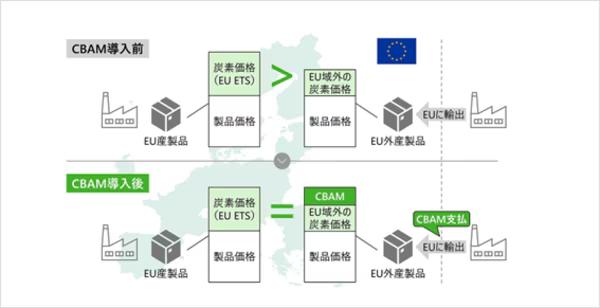
Source: Ministry of the Environment, Decarbonization Portal[Interview with Experts] Understanding Carbon Pricing from the EU's Carbon Border Adjustment Measures (CBAM)
Which businesses and products are subject to CBAM?
The businesses subject to CBAM are EU businesses that import the target products from outside the EU. The target products and the types of GHGs that must be reported for each product are as follows:
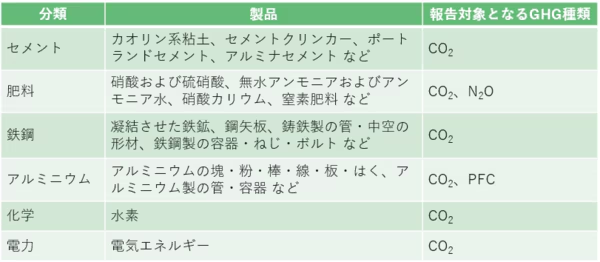
*For details on the products covered, you need to check the CN code (EU tariff classification) listed in Annex I of the CBAM Regulation (List of goods and greenhouse gases).
During the transition period, there is no obligation to pay surcharges, but there is an obligation to submit CBAM reports quarterly. After full implementation (January 2026 onwards), importers will be required to purchase "CBAM certificates" as a form of surcharge.
Source: European Union REGULATION (EU) 2023/956 OF THE EUROPEAN PARLIAMENT AND OF THE COUNCIL of 10 May 2023 establishing a carbon border adjustment mechanism
Impact on Japanese companies
Since the products subject to the transition period are all exported in small quantities from Japan to the EU, the impact on Japanese companies is expected to be limited.
However, the European Commission has indicated its intention to consider expanding the application of CBAM. This includes organic chemicals and polymers, as well as downstream value chain products that use the products covered by CBAM (for example, automobiles, auto parts, and industrial machinery that use steel). If the scope of application is expanded, it is highly likely that the majority of Japan's major exports to the EU will be subject to CBAM, and the expected impact will be significant, so it is important to continue to closely monitor developments.
On the other hand, Japanese companies are not directly subject to reporting obligations under CBAM unless they conduct import business within the EU. However, if they export the target products to the EU, importers may request information such as GHG emission data for the products. In preparation for such requests, it is necessary to establish a system for calculating the carbon footprint (CFP) of products.
▼Click here for articles about "carbon footprint"
In Japan, industry-specific research and studies on CFP calculation are already underway. For example, the Japan Screw Manufacturers Association, upon learning that screws and bolts would be subject to CBAM, conducted a survey of its members to assess the extent of CBAM's impact on the industry and reported the results to the Ministry of Economy, Trade and Industry (METI). Subsequently, METI created CFP calculation guidelines for screws and bolts that comply with CBAM, and is expected to release the official version soon.
Reference: Japan External Trade Organization Explanation of the EU Carbon Border Adjustment Mechanism (CBAM) (Basic Version)
Japan Screw Manufacturers Association Regarding the Japan Screw Manufacturers Association's response to the EU-CBAM system
summary
During the transition period, the products covered by CBAM are limited to certain sectors, so the impact on Japanese companies is expected to be minimal. However, when the scope of products covered expands during full implementation, it could have a significant impact on many Japanese companies (especially those on the production side).
To maintain competitiveness in the future, we recommend that you keep a close eye on CBAM and industry trends, and establish an emissions calculation system before receiving reporting requests from your business partners.
booost technologies provides solutions that visualize CO2 emissions from facilities such as factories and offices in real time, broken down by time of day, equipment, etc. Primary data/actual measured values of CO2 emissions are securely acquired from sensors installed on each piece of equipment via industrial routers and equipment APIs. This data is then used in our CO2 emission visualization and decarbonization platform, "booost GXIt is possible to automatically import data and visualize CO2 emissions from primary data/actual measurements of factories and facilities. For more details on this initiative and a demonstration, please feel free to contact us using the information below.