
We are increasingly seeing information about carbon neutrality, decarbonization, climate change, ESG, and so on. You probably see many abbreviations such as TCFD, TNFD, SBTi, etc. But are you familiar with the organization called CDP?
CDP encourages companies and organizations to disclose environmental information by sending questionnaires to those organizations and evaluating and publishing the progress of their environmental stewardship efforts based on their responses.
This article is intended to be helpful to those considering responding to the CDP questionnaire.
At booost technologies, we offer "booost GX," a management system for calculating and reducing CO2 emissions, and "booost Supplier," which enables visualization and reduction of CO2 emissions in the supply chain and sharing of ESG data!
You can download detailed information here!
● Service introduction material for "booost GX"
What is CDP?
CDP (formerly known as the Carbon Disclosure Project) is a non-governmental organization (NGO) founded in the UK in 2000, which operates a global information disclosure system for major companies and local governments worldwide. It has been active in Japan since 2005.
One notable activity is that, at the request of institutional investors and others, questionnaires are sent to target companies and organizations, each response is evaluated based on a unified scoring standard, and the results are published.
Currently, it has become the global standard for the "E" in ESG information disclosure, and by responding to CDP, companies can disclose information to multiple investors and client companies.
In Japan, the number of companies and organizations to which questionnaires are sent expanded from 150 in 2006 to 500 in 2009, and since 2011, questionnaires have been sent primarily to 500 companies selected based on those listed in the FTSE Japan Index. According to the "CDP Climate Change Report 2022: Japan Edition" *1, more than 1,700 Japanese companies responded in 2022, and the number of companies responding voluntarily has been increasing in recent years. Many people may already be aware that questionnaires in the climate change field were expanded to include all companies listed on the Tokyo Stock Exchange Prime Market in 2022.
Initially, the questionnaires sent out only covered climate change, but from 2009, water security was added, and from 2013, forestry was added. In 2018, the questionnaires were aligned with the TCFD recommendations, and in 2022, questions on biodiversity were added to the climate change questionnaire (though this was not included in the scoring in 2022).
In 2023, questions and indicators related to plastics will be added (details to be published in early 2023) *2. The questionnaire is updated annually to encourage the disclosure of necessary environmental information and more effective action.
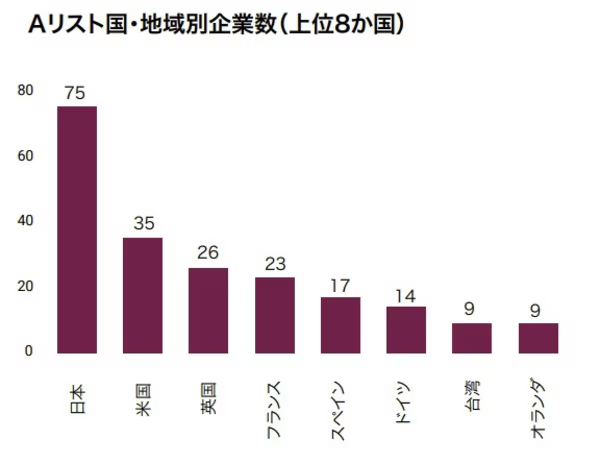
The responses are ultimately assigned a score from A to D, which indicates the progress of environmental stewardship (companies that do not respond will receive an F score). In the climate change field in 2022, 75 Japanese companies were ranked with the highest possible score of A, making Japan the country with the most A-listed companies by country/region (see figure below).
source:
*1:April 2023, "CDP Climate Change Report 2022: Japan Edition" (Editor's note: Replaced with the 2022 version)
*2:"CDP Announces Expanded Disclosure of Plastics-Related Information" (Released September 22, 2022)
Benefits of answering the CDP questionnaire
The internal benefits include the need to understand the climate change impacts on your business as real risks and opportunities through the process of preparing responses to the CDP questionnaire, which ultimately leads to the development of adaptation strategies with short-term, medium-term, and long-term timeframes. You can also learn about the initiatives of other companies and apply that knowledge to your own efforts. Furthermore, by continuing to respond every year, you can track the progress of your company's goals and initiatives.
Externally, this serves as a way to demonstrate that the company is committed to disclosing climate change-related information. Disclosing information through CDP leads to disclosure to multiple ESG institutional investors. In particular, investors and business partners can obtain and compare company information from the perspective of climate change adaptation, as the answers to standardized questions and evaluations are based on scoring criteria.
Furthermore, since CDP's climate change questionnaire is aligned with the TCFD (Task Force on Climate-related Financial Disclosures), responding to CDP will also prepare you for TCFD-compliant information disclosures. We will discuss the TCFD in another article, but its importance as a climate-related information disclosure has been increasing in recent years, so it is worthwhile to prepare for it.
Related seminars:Current climate change disclosure responses
summary
Companies considering disclosing climate change-related information may want to start by responding to the CDP questionnaire and then enhance their efforts.
booost technologies Inc. is promoting decarbonization by offering a carbon management cloud that enables the automatic calculation, visualization, management, and reporting of CO2 and other emissions.booost GXWe will provide support for the implementation of [the system] and, as a CDP scoring partner, support the disclosure of information on climate change-related international frameworks, including TCFD.
Please feel free to contact us using the information below.