
At booost technologies, we offer "booost GX," a management system for calculating and reducing CO2 emissions, and "booost Supplier," which enables visualization and reduction of CO2 emissions in the supply chain and sharing of ESG data!
You can download detailed information here!)
What are supply chain emissions?
Supply chain emissions refer to the total CO2 emissions related to all business activities, including not only direct CO2 emissions within the company but also indirect emissions associated with the company's operations.
According to the Ministry of the Environment's explanation*,"This refers to the total emissions from all aspects of business activities, not just those of the business itself. In other words, it includes greenhouse gas emissions generated from the entire process, from raw material procurement, manufacturing, logistics, sales, and disposal."It is said that...
Supply chain emissions are calculated by summing Scope 1 emissions, Scope 2 emissions, and Scope 3 emissions. Scope 1 emissions refer to direct greenhouse gas emissions by the business itself (fuel combustion, industrial processes). Scope 2 emissions refer to indirect emissions associated with the use of electricity, heat, and steam supplied by other companies. Scope 3 emissions refer to indirect emissions other than Scope 1 and Scope 2 (emissions by other companies related to the business's activities).
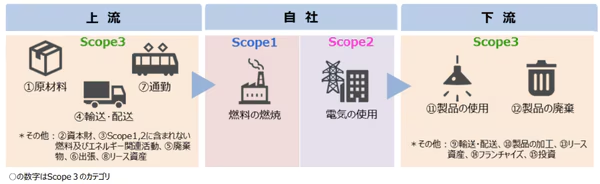
*source:Regarding the calculation of emissions – Green Value Chain Platform | Ministry of the Environment
Why is calculating supply chain emissions important?
Our society faces the challenge of climate change, which has the potential to impact life and the environment on Earth. One of the main causes of this problem is the massive emission of greenhouse gases from industrial activities. While companies are already becoming more aware of their direct emissions (Scope 1 and Scope 2), this alone does not provide a complete picture. They are required to understand and manage emissions that occur throughout the entire lifecycle of products and services—that is, emissions across the entire supply chain.
The diagram below shows the average emission distribution (percentage of emissions) for each category of Scope 1, Scope 2, and Scope 3 emissions across various industries in Japan. Industries where Scope 3 Category 1 (purchased products and services) and Scope 3 Category 11 (use of sold products) account for 201 TP3T or more are marked. In many industries, the proportion of Scope 3 Category 1 and Category 11 emissions is large, highlighting the importance of calculating and reducing Scope 3 Category 1 and Category 11 emissions.
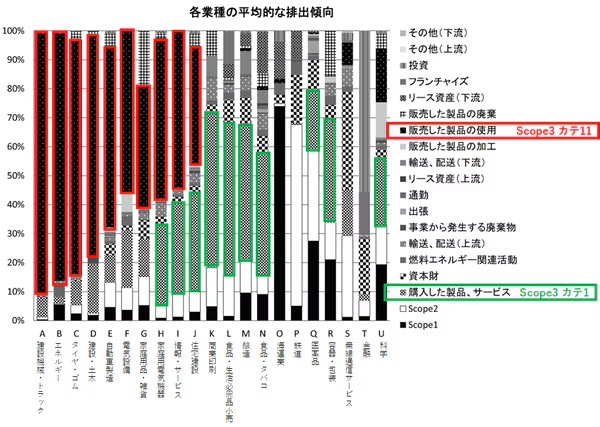
Source: Based on "LCA Journal April 2015" and processed by our company.
https://www.jstage.jst.go.jp/article/lca/11/2/11_129/_pdf/-char/ja
Benefits of calculating supply chain emissions
By calculating and managing emissions across their entire supply chain, companies can gain the following advantages:
Improved transparencyBy disclosing supply chain emissions, companies can demonstrate their commitment to sustainability and gain the trust of their stakeholders.
Risk ManagementThis helps prepare for and respond to climate change risks, enabling you to adapt to future regulatory changes and market trends.
Improved efficiency and cost reductionIdentifying emission sources allows us to develop more effective reduction strategies and find opportunities to lower costs.
Improving innovation and competitivenessThis provides an opportunity to explore new business models, products, and services, thereby enhancing competitiveness.
However, the ultimate goal of calculating supply chain emissions is not merely to pursue numbers, but to plan and implement concrete improvement measures based on the results revealed. Furthermore, these efforts are not temporary, but require a continuous pursuit of improvement.
At the same time, companies understanding and addressing the environmental impact of their supply chains also enhance their corporate value. Stakeholders such as consumers, investors, and employees are demanding that companies take environmental issues seriously. Therefore, understanding and disclosing the environmental impact of a supply chain helps to increase a company's brand value and credibility, and secure a competitive advantage.
Ultimately, calculating supply chain emissions is a crucial way for companies to demonstrate how they address the global challenge of climate change and how they fulfill their social responsibilities. It is an unavoidable challenge for all of us striving for a sustainable future.
Method for calculating supply chain emissions
For calculating supply chain emissions, the Ministry of the Environment provides a document outlining the basic calculation procedures. Also,Ministry of the Environment's Green Value Chain PlatformThis document contains various tools useful for calculating supply chain emissions. By utilizing these tools, you can calculate CO2 emissions across the entire supply chain using your own Excel tool.
Supply chain emissions are calculated by summing up Scope 1, Scope 2, and Scope 3 emissions. Scope 1 refers to direct greenhouse gas emissions by the business itself, Scope 2 refers to indirect emissions associated with the use of electricity, heat, and steam supplied by other companies, and Scope 3 refers to indirect emissions other than Scope 1 and Scope 2 (emissions by other companies related to the business's activities).
To calculate supply chain emissions, it is necessary to identify the activity level and emission intensity. Activity level is an indicator that represents the amount of greenhouse gases generated by business activities, while emission intensity is an indicator that represents the amount of CO2 emitted per unit of activity. Specifically, it is calculated using the following formula.
Supply chain emissions = Scope 1 emissions + Scope 2 emissions + Scope 3 emissions
Steps for calculating supply chain emissions
The calculation of supply chain emissions involves the following steps:
Identifying emission sourcesThis involves surveying the entire supply chain of a company to identify which parts account for the majority of emissions. This includes raw material sourcing, manufacturing processes, transportation, and product use and disposal.
Data collectionWe collect data to measure specific emissions from identified emission sources. This includes energy consumption, raw material usage, and transportation distance.
Emissions calculationBased on the collected data, we calculate the emissions from each emission source. This is done using internationally recognized guidelines such as the GHG Protocol.
Analysis and evaluation of resultsWe analyze the calculated emissions and evaluate the results. This involves investigating emission trends, major emission sources, and areas where reductions are possible.
Formulating improvement measuresBased on the calculation results, we will formulate specific measures to reduce emissions. These include improving energy efficiency, introducing renewable energy, and reducing waste.
summary
Calculating emissions across the supply chain allows companies to gain a detailed understanding of their environmental impact and define specific actions to improve it. The results not only reduce greenhouse gas emissions but also have a multifaceted positive impact, such as improving corporate efficiency, mitigating risks, creating new business opportunities, and enhancing brand image. Corporate decarbonization is part of a society-wide effort toward sustainability, and its success benefits all stakeholders.
However, calculating supply chain emissions and using that information to drive decarbonization is a difficult task that involves many challenges, but the results are extremely valuable.
booost technologies offers a solution that streamlines the collection and management of supplier emissions and emission sources.booost SupplierWe offer the following service. If you would like to streamline your supply chain emissions calculation using Excel, or if you would like to perform Scope 3 calculations using primary data from suppliers, please feel free to contact us using the information below.