
At booost technologies, we offer "Sustainability ERP," which enables the collection and visualization of non-financial information, from CO2 emissions in the supply chain to ESG data, including "booost GX," a management system for calculating and reducing CO2 emissions, and streamlines reduction and improvement activities on a single platform.
Detailed information can be downloaded from here.
● Service introduction materials for "booost GX"
What is a carbon footprint (CFP)?
One concrete measure to reduce CO2 emissions is the Carbon Footprint of Product (CFP). It is one way to visualize emission reductions through a company's direct business operations. In addition to establishing a system for calculating GHG emissions from Scope 1 to 3, some companies may be considering calculating their CFP.
CFP calculates CO2 emissions by converting the total GHG emissions generated throughout the entire lifecycle of a product or service, from raw material procurement to disposal and recycling, into equivalent CO2 emissions.
When calculating carbon footprints, the "Carbon Footprint Guidelines" published by the Ministry of Economy, Trade and Industry and the Ministry of the Environment are helpful. The "Practical Guide" and its explanatory materials were updated in March 2024.
Reference: Ministry of Economy, Trade and Industry, Ministry of the Environment, "Carbon Footprint Guidelines" (March 2023)Part 1 Part 2
▼Please also see this article.
Introduction to CFP calculation case studies/interviews
~Kahei Co., Ltd. (manufacturer of synthetic and artificial leather, Osaka Prefecture)~
In 2023, our company provided support for CFP calculations.Kahei Co., Ltd.We interviewed Mr. Tadokoro, President and CEO of [company name], about the reasons for calculating CFP, the process, and the advantages and disadvantages.
Kahei Co., Ltd. has implemented "booostGX," a CO2 emission calculation tool, and has also obtained SBT certification. Headquartered in Osaka Prefecture, the company handles everything from the design and development to the manufacturing of synthetic leather for various applications such as vehicles and sporting goods.

— What prompted you to start working on CFP calculations?
The impetus for this initiative came during a period when our business was impacted by the COVID-19 pandemic, when we began to consider "our customers' next needs." At the time, it was rare, but we were starting to receive questionnaires from our clients in the automotive industry regarding CO2 emissions. We were convinced that the trend towards decarbonization would intensify, and we decided to address this issue early on in order to properly comply with CFP disclosure requirements in the future.
Based on our experience calculating our own CO2 emissions and obtaining SBT certification, we anticipated that calculating CFP would also take time. We felt that we wouldn't be able to keep up if we waited until a customer requested it, so we thought now was the time to get started ahead of the competition.
— How did you go about calculating your CFP?
We started with a two-person team, beginning with selecting the target products. Considering that it is our main product and that the automotive industry is required to take decarbonization measures, we decided to target synthetic leather products for vehicles.
As expected, the calculation took a very long time. The raw materials used in the target product are unique and numerous, so we had to start by researching the values (emission factors) to be used in the calculation.
Boost provided support from the very beginning, including guiding us on how to find the numerical values used in the calculation. They not only guided us through the process but also offered several suggestions for how to handle situations where emission factors corresponding to raw materials could not be found or actual measured values could not be obtained. The CFP calculation process is complex, and if you start worrying about it, there's no end to it. When we got stuck, Boost presented us with options, which allowed us to focus on decision-making, and that was extremely helpful.
During the support period with booost, we held internal study sessions. Many employees, including sales staff, participated, absorbing knowledge to communicate CFP to clients in their own words. We were able to get answers to detailed questions and create a forum for shared understanding within the company. I feel like we have made progress as a company.
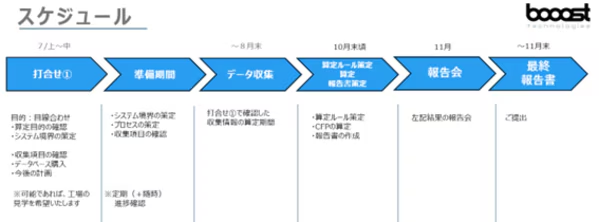
The support period was approximately four months.
— What are the benefits of working on CFP calculations?
What I gained was the ability to equip our sales representatives with the "tools" that would differentiate them from competitors.
Recently, we received high praise from a customer for a product for which we had calculated the Carbon Dioxide (CFP). The product had strict specifications, making it difficult to differentiate from competitors' products, but our presentation of the CFP led to its adoption. This customer is actively working on decarbonization and commented, "Other companies don't disclose their emissions, but Kahei disclosed not only emissions but also CFP." I believe that our employees' understanding of CFP through training sessions contributed to this positive customer evaluation.
Another benefit was gaining an objective understanding of our emission reduction measures through our own products. The calculation process allowed us to visualize emissions from raw material procurement and emissions from our own production processes.
This experience has helped us clarify the effective cost reduction measures that our company should implement. We plan to start working on them in the future.
— What are the disadvantages?
It certainly takes time and effort. To put it bluntly, since the manufacturing industry is already well-established in its efforts to utilize resources in a circular manner through reuse and recycling, CFP is undeniably still in the early stages.
On the other hand, in terms of "meeting customer needs," there are only advantages. Our sales representatives understand CFP and are able to explain it, generating interest in our customers. We feel that the benefits outweigh the disadvantages.
— Please tell us about your ultimate goals and vision for using CFP.
We consider CFP to be an integral part of our product quality control. Through CFP, we not only formulate decarbonization guidelines for our products, but it also serves as one of the indicators for investment decisions across our entire business. Decarbonization efforts, including emissions calculations, are painstaking work, but we will continue to raise awareness both inside and outside the company. We believe this consistent approach will be reflected in our products.
We have now expanded our CFP calculation products to three. Since the calculation process is time-consuming, we will continue to increase the number of products based on customer requests. We learned the concepts and methods for verifying CFP figures from booost, so we are now able to perform the calculations independently.
— Do you have a message for those who are about to start calculating their CFP (Certified Financial Planner)?
If you feel it's necessary given the trends in the external environment, we recommend starting a CFP calculation. Not only will it differentiate you from competitors, but it will also help you confirm your company's and your products' position in the context of decarbonization. In other words, it can be used as an opportunity to analyze and recognize your company's strengths and weaknesses from the perspective of decarbonization, allowing you to make correct decisions about future actions.
Furthermore, I feel that working on CFP calculations has led to new connections and opportunities.
Editor's Postscript
Thank you for sharing your valuable insights. Hearing about the motivations behind your emissions and CFP calculations, I sensed a "let's give it a try" attitude. This interview truly reflected Mr. Kahei's approach to "making things in a fun and engaging way."
I was particularly impressed by how the CFP calculation led to business opportunities and how it helped analyze your company's strengths and weaknesses in the context of decarbonization.