
In August 2023, the European Union (EU) announced that the "European Battery Regulation" would come into effect to strengthen the existing Battery Directive, and would be applied from February 2024.
These regulations apply to all businesses distributing batteries in the EU, regardless of size or location. They cover all types of batteries used within the EU and propose regulations covering the entire lifecycle with the aim of minimizing environmental impact. Failure to comply may result in restrictions on exports to the EU.
This time, I will briefly explain the contents of the European Battery Regulation.
Background of the European Battery Regulation
One of the reasons behind the enactment of the European Battery Regulation is the EU's goal of achieving net-zero greenhouse gas emissions by 2050, as outlined in the "European Green Deal" announced in 2019.
Furthermore, as electric vehicles are expected to become the mainstream of the automotive industry, rather than fossil fuel vehicles, battery demand is projected to expand rapidly and production will increase. This necessitates a legal framework to reduce the environmental impact of battery products and promote their circular use. From an economic perspective, it is also possible to create a sustainable economic strategy that enhances competitiveness in the battery industry market through the development and widespread adoption of environmentally friendly batteries.
Reference: Japan External Trade Organization EU battery regulations and developments in battery production and recycling, primarily in Germany.
Subject to regulation
The European Battery Regulations regulate all batteries sold within the EU, regardless of their shape, volume, weight, design, material composition, chemical composition, application, or purpose.
The detailed categories subject to regulation are as follows:
- Portable battery
- Battery for starting, lighting, and ignition (SLI)
- Batteries for light transport vehicles (LMTs)
- Batteries for electric vehicles (EVs)
- Industrial batteries
- Batteries that are incorporated into a product or designed to be incorporated into a product.
If you fall into multiple categories, you will be considered to belong to the category with the strictest requirements. However, the following are exempt:
- Equipment related to the protection of vital security interests, weapons, ammunition, and war materials in Member States, excluding products not intended for specific military purposes.
- Equipment designed to be sent into space
Main requirements
In addition to the existing restrictions on chemical substances contained in batteries, the following four items are the main points that have been strengthened under the European Battery Regulation.
- Carbon footprint reporting obligation
Carbon footprint (CFP) is a measure of greenhouse gas emissions from the procurement of raw materials for goods and services to their disposal and recycling. European battery regulations require manufacturers to prepare a CFP declaration for each battery type for each manufacturing plant, certified by a third-party verification body. However, the usage phase can be excluded from the calculation as it is not directly related to the manufacturer's impact.
The start date for CFP filing is determined for each type of battery; for example, for EV batteries, it is scheduled to be applied from February 2025.
Furthermore, starting February 18, 2028, a CFP (Chemical Formula Product) limit will be introduced, and products exceeding the set limit will no longer be able to be sold within the EU. - Supply chain due diligence
The European Battery Regulation requires businesses distributing batteries in the EU market to procure designated materials and products containing designated materials responsibly, and mandates investigations by third-party verification bodies to certify risks such as environmental pollution and human rights abuses at their suppliers, effective from August 18, 2025.
Furthermore, businesses are required to establish management systems for their supply chains, manage and publish due diligence results and third-party verification reports. - Digital registration of product information
To enhance transparency in the battery value chain and enable information exchange and tracking, from February 18, 2027, it will be mandated that information such as performance, raw material composition, and CFP be stored in a digital recording system called "Battery Passport" for LMT batteries, industrial batteries exceeding 2kWh, and EV batteries.
Furthermore, authorized individuals must be able to scan the registered information via QR code at any time. - Recycled material content
From August 18, 2028, for industrial batteries, EV batteries, and SLI batteries exceeding 2kWh (excluding those with external storage only), if the active materials include cobalt, lead, lithium, or nickel, information regarding the proportion of each active material, as well as the proportion of those materials recycled from waste generated during the production stage or from end-of-life waste, must be disclosed by year, manufacturing plant, and model.
Furthermore, from August 18, 2031 onwards, it will be necessary to prove in technical documentation that the proportion of recycled materials for each of the above substances is equal to or greater than the minimum content rates listed below.
– Cobalt: 16%
–Lead: 85%
– Lithium: 6%
– Nickel: 6%
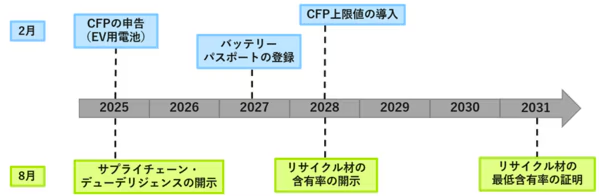
When will the main requirements of the European Battery Regulation come into effect?
summary
The European Battery Regulation places a strong responsibility on battery businesses to consolidate and manage information across the entire value chain. In light of this trend, it is urgent for Japanese businesses, especially automakers operating electric vehicle businesses in the EU, to address the CFP (Critical Factor Productivity) requirements for EV batteries by February 18, 2025. Considering the effort involved in data collection and calculation, there is no time to spare, and preparation must be carried out immediately.
To maintain competitiveness in the EU market, it is essential to deepen your understanding of these regulations, grasp their impact on your company and suppliers, develop a response plan, and implement it.
For companies in the battery supply chain, it is crucial to conduct due diligence on matters such as calculating the CFP (Chemical Factor Productivity) of battery raw materials and addressing environmental pollution and human rights abuses within their own operations, in order to prepare for customer requests.
booost technologies provides solutions that visualize CO2 emissions from facilities such as factories and offices in real time, broken down by time of day, equipment, and more.
Primary/actual CO2 emission data is securely acquired from sensors installed on each piece of equipment, via APIs of industrial routers and other devices. This data is then used in our CO2 emission visualization and decarbonization platform, "booost GXBy automatically importing data and visualizing CO2 emissions from primary data/actual measurements of factories and facilities, it is possible to calculate the precise carbon footprint for each product and service.
For more details about our initiatives or to request a demonstration, please feel free to contact us using the information below.