
The Energy Conservation Act was amended in 2022 and came into effect in April 2023. The need for thorough energy conservation and rationalization of all energy use has increased in order to achieve domestic GHG emission reduction targets, leading to significant changes. The first periodic report under the amended law must be submitted by the end of July 2024, reporting the aggregated results for fiscal year 2023.
This article explains the key points of the revised Energy Conservation Act. In addition to understanding the outline of the revisions, it will discuss the energy-saving actions required of businesses and the new information that companies should collect.
Even if you are not subject to reporting requirements under the Energy Conservation Act, please read this to understand the key points of energy-related information gathering necessary for realizing a decarbonized society.
You can download the solution documentation here.
● Service introduction materials for "booost GX"
Background of the amendment to the Energy Conservation Act
In order to achieve Japan's current goals of "achieving carbon neutrality by 2050" and "reducing GHG emissions by 461 TP3 T by FY2030 (compared to FY2013)," it is necessary to re-examine current energy usage patterns and significantly change the energy supply and demand structure.
The Energy Conservation Act was originally enacted to rationalize the use of fossil fuels, but it has now been amended to also address the promotion of the use of non-fossil fuels and the rationalization of the use of energy other than fossil fuels in general.
Major changes
This section explains the main changes in this revision.
Rationalizing the use of all energy.
Previous energy conservation laws focused on fossil fuels, but now they require the rationalization of all energy sources, including non-fossil fuels. As a result, non-fossil fuels are now included in the reporting requirements, as shown in the diagram below. Even if renewable energy sources with low environmental impact are used, it is now necessary to include them in the total energy consumption figures.
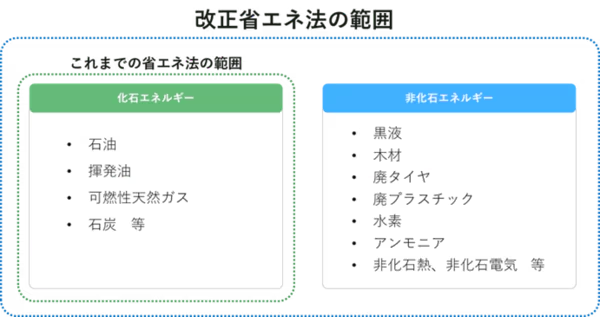
Transition to non-fossil energy
To promote the use of non-fossil energy, certain businesses are required to report on their targets and usage status for transitioning to non-fossil energy. Calculating non-fossil energy usage requires careful aggregation, including not only simply summing up usage amounts but also multiplying by coefficients (such as coefficients for "weighted non-fossil" electricity) and excluding supplies to other companies. Furthermore, depending on the industry, target settings may be required.
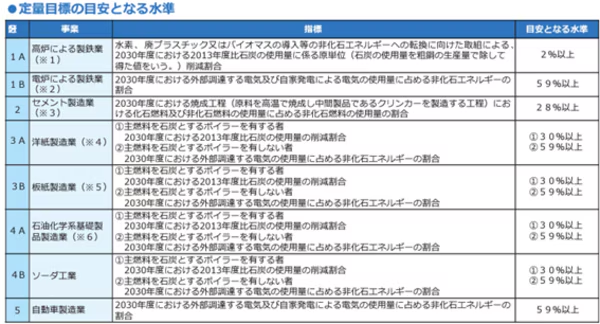
[Source] Energy Conservation Law Handbook: Factory and Business Establishment Edition, Revised 2023 (Agency for Natural Resources and Energy)
https://www.enecho.meti.go.jp/category/saving_and_new/saving/media/data/shoene_tebiki_01.pdf
Optimization of electricity demand
Depending on the time of year and day, renewable energy may be generated in excess of demand, or supply may not meet demand, necessitating the overall optimization of electricity supply and demand management. Therefore, certain businesses are now required to report on demand response (measures that allow electricity consumers to flexibly adjust their electricity usage according to the supply situation) in accordance with the electricity supply and demand situation. Furthermore, they are required to report on the "electricity demand optimization evaluation unit," which is calculated by considering the "electricity demand optimization coefficient" for monthly or hourly electricity usage, and businesses are now required to make efforts to reduce this unit (or energy consumption unit) by an average of 1% or more per year in the medium term.
Points to note in the report
For periodic reporting, the creation support tools (Excel version, app version) previously provided and used by the Agency for Natural Resources and Energy will be discontinued.EEGSThe submission format has been changed to an online system called EEGS. For first-time users, it is necessary to set up an ID and password in advance, and to mail in the required documents. It is said that it takes about a month before you can use the system. Considering the reporting deadline, it is important to start the process as early as possible.
Furthermore, for reports from specific businesses, the submission of Tables 1 through 12 is required, and the reporting format has also been revised. Therefore, a reasonable amount of time is needed to understand and adapt to the changes. We recommend starting with ample time to ensure accurate reporting.
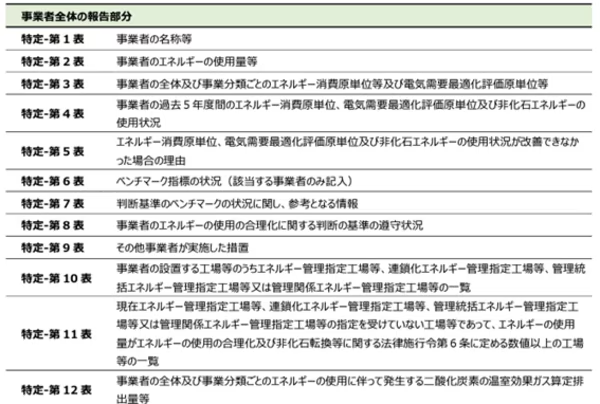
[Source] Guidelines for Completing Periodic Reports and Medium- to Long-Term Plans under the Energy Conservation Act (2024 Edition) (Agency for Natural Resources and Energy)
https://www.enecho.meti.go.jp/category/saving_and_new/saving/enterprise/factory/support-tools/data/kojo-kinyuyoryo24.pdf
For information on how to write periodic reports, help desk information, and support tools (tools for calculating non-fossil fuel ratios and optimizing electricity demand), please refer to the following:Portal site of the Agency for Natural Resources and EnergyReference information is available there.
summary
This revision expands the scope of energy covered by the Energy Conservation Act, and the indicators used to measure energy efficiency have become more complex. This trend is expected to continue. If businesses continue to compile data in Excel or similar software for each location and energy type, it will become difficult to calculate appropriate reporting values within the deadline. It is desirable that stakeholders understand that reporting under the Energy Conservation Act is becoming more sophisticated and take steps to educate their staff and select appropriate calculation tools.
booost GXOur software promptly adapts to these legal revisions, and the new version enables automatic calculation of aggregated data and indicators in accordance with the revised Energy Conservation Act, and outputs reports that conform to the reporting format. booost GX users can receive training sessions and videos related to the Energy Conservation Act (and other topics related to GHG emission calculation in general), which can help improve the understanding of their staff. If you are considering implementing our software, please contact us using the information below.