
In recent years, an increasing number of companies have been calculating their GHG emissions and setting reduction targets. While many companies are disclosing this information, the difference between this and SBT certification is not always fully understood. This article explains the requirements and application process for SBT certification.
What is SBT certification?
Some people may be confusing "SBT" and "SBTi." This article will begin by explaining the difference between them.
SBT (Science Based Targets) is an abbreviation for "science-based targets," and it is in line with the goal agreed upon in the Paris Agreement to "limit the rise in average temperature to less than 2 degrees Celsius, and ideally to 1.5 degrees Celsius."
The Science Based Targets initiative (SBTi) is an international organization that certifies whether greenhouse gas reduction targets are set based on scientific evidence. It was established in 2015 by the United Nations Global Compact, WRI, WWF, and CDP.
Therefore, SBT certification is a process in which the SBTi certifies whether the targets set by a company are aligned with the Paris Agreement.
The number of companies obtaining SBT certification is increasing.
As of March 2024, there were 4,779 SBT-certified companies worldwide, of which 904 were Japanese companies. In the year from March 2023, the number of Japanese companies increased by 479, or nearly double. As a result, Japan surpassed the UK, which was the top country last year, to become the number one country.
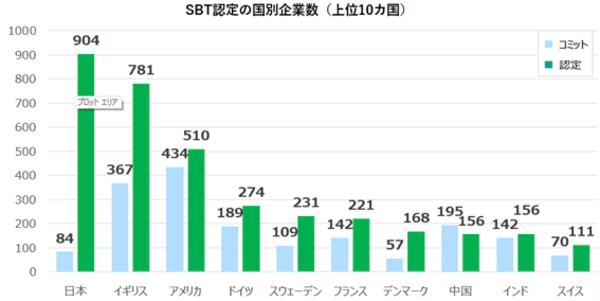
Source: Ministry of the Environment, "SBT Detailed Information" SBT_syousai_all_20240301.pdf (env.go.jp)
The background is
The increasing number of companies obtaining SBT certification stems from the fact that it allows them to effectively demonstrate their sustainability through decarbonization efforts. With growing interest from investors, customers, and employees, setting GHG reduction targets offers numerous benefits, including improved reputation, risk mitigation, and the creation of new business opportunities. This trend enhances corporate credibility and competitiveness, generating long-term value.
Benefits of obtaining SBT certification
This section outlines the benefits that companies can gain from obtaining SBT certification, broken down by stakeholder.
① Benefits for investors
SBT certification demonstrates that a company has goals aligned with the Paris Agreement, improving confidence among institutional investors such as pension funds. A survey by SBTi found that 52% of certified companies reported increased investor confidence.
② Benefits for customers
For customers who prioritize decarbonization targets, SBT certification is seen as a reliable commitment, leading to improved brand strength and competitiveness. According to an SBTi survey, 77% of certified companies reported an improvement in brand reputation, and 55% reported an improvement in competitiveness.
③ Benefits for suppliers
SBT certification enables goal setting across the entire supply chain and promotes collaboration toward decarbonization. This is expected to lead to the creation of sustainable supply chains and improved risk management.
④ Benefits for internal use
Setting ambitious goals fosters motivation and innovation within a company. It leads to the adoption of new technologies and the creation of new business models, and according to an SBTi survey, 63% of companies feel that it has promoted innovation.
To obtain SBT certification
As mentioned at the beginning, the difference between a company disclosing its GHG emissions and reduction targets and obtaining SBT certification lies in whether the company sets targets based on its own standards or on international standards. In this section, we will explain the necessary preparations and procedures for obtaining certification based on the requirements of "Science-Based Targets (SBT)" as defined by the SBTi.
SBT certification has two types of goals: short-term goals (within 5-10 years from the submission date) and long-term goals (goals looking 10 years or more into the future, up to 2050). This article will focus on explaining short-term goals.
Preparation
This explains the preparations needed to apply for SBT certification.
Step 1. Confirm the purpose of obtaining SBT certification and establish an internal system.
Obtaining SBT certification requires more than just submitting an application; it's crucial to understand the benefits, requirements, and importance of SBT certification. Furthermore, it's necessary to establish internal systems to effectively implement SBT initiatives.
Step 2. Understanding SBT Requirements
As mentioned earlier, SBT certification is a process in which the SBTi certifies whether a company's reduction targets are aligned with the Paris Agreement. To obtain this certification, companies must calculate their GHG emissions and set reduction targets as required by the SBTi. This section will explain the SBT requirements in detail.
■ Reduction targets and scope of GHG calculation
- Organizational coverage: It is recommended that this cover the entire group and align with the organizational scope of corporate accounting.
- GHG coverage: Based on the GHG protocol company standards, all relevant GHGs must be covered.
- Scope Coverage: The scope must cover the group's entire Scope 1 and Scope 2 emissions. For Scope 3, a Scope 3 target is mandatory if a company's Scope 3 emissions account for more than 40% of the total of Scope 1, 2, and 3 emissions.
- Emissions coverage: When calculating emissions and setting targets, up to 5% of the total Scope 1 and 2 emissions can be excluded. Short-term targets for Scope 3 must cover at least two-thirds (67%) of the entire Scope 3 category, or engagement targets with suppliers and customers must be set.
■ Requirements for calculating emissions
- Scope 2: Clearly indicate whether the calculation was based on location criteria or market criteria.
- Scope 3: A comprehensive inventory covering each category is required.
- Carbon credits (third-party reductions): These cannot be used as a means of reduction. However, they can be considered when setting long-term targets.
- Reduction contribution (reduction compared to normal levels by our products, etc., in society): Not included in SBT targets.
■ Setting Goals
- Target year setting period: The target year must be set within a minimum of 5 years and a maximum of 10 years from the time of submitting the target to SBTi. The base year must be selected from 2015 or later.
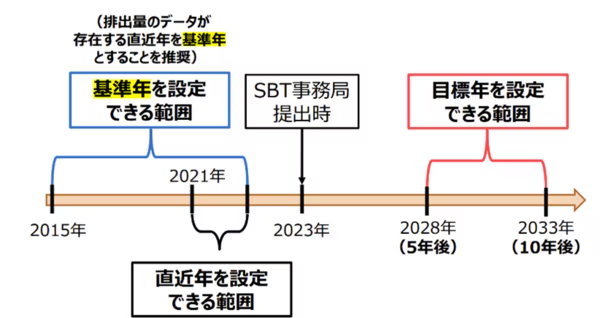
Source: Ministry of the Environment, "SBT Detailed Document" SBT_syousai_all_20240301.pdf (env.go.jp)
- Temperature reduction targets: A target of 1.5°C is required for Scope 1 and 2, and a target of 2°C is required for Scope 3.
- Target format: Scope 1 and 2 targets are total volume targets (unit intensity targets are also acceptable if reduction requirements are met), while Scope 3 targets include total volume targets, engagement targets, or sector-specific targets.
■Sector-specific targets are requirements defined for each sector and are described in the SBT sector-specific guidance. The industrial sectors for which sector-specific guidance is available are as follows:
- Clothing/Shoes Aviation
- chemistry
- financial institutions
- Exploration, extraction, mining, and/or production of fossil fuels
- Sales, transportation, and distribution of fossil fuels
- Fossil fuel infrastructure/services (dedicated/non-dedicated)
- Information and communication technology provider
- Industrial sector: Iron and steel, cement, aluminum, pulp/paper
- OEM (Original Equipment Manufacturer) / Automobile Manufacturer
- Power generation
- Service/Commercial Building
- Transportation services
Step 3. Calculate GHG emissions and set reduction targets based on SBT requirements.
Certification process
Next, we will explain the process of obtaining SBT certification and the steps involved after obtaining it.
The SBT application process is as follows:

Let's take a quick look at each step.
Step 1: Application and Review
① [Optional] Submission of a Commitment Letter
A Commitment Letter is a declaration to set SBT (Science Based Targets) goals within two years.
After submission, the results will be published on the websites of the SBT Secretariat, CDP, and WMB.
② Setting goals and submitting the application form
Submit the Target Submission Form to the secretariat and book your review date using the SBTi booking system.
③ Validation of targets and response by the secretariat (fee applies: for general companies, USD 9,500 for short-term targets)
The SBT Secretariat will review whether the goals meet the certification criteria and notify you of the results by email (the reasons for rejection will also be included).
④ If approved, it will be published on the SBT website, etc.
Step2 After certification
⑤ Report on progress
We will report and disclose our emissions and the progress of our countermeasures once a year.
⑥ Regularly review goals
Regularly review the validity of the goals, and if significant changes occur, reset the goals as necessary (re-evaluate at least once every five years).
summary
Obtaining SBT certification requires setting targets in accordance with established standards. This article explains those specific requirements. Accurate calculation of GHG emissions and setting reduction targets aligned with the Paris Agreement are essential for obtaining SBT certification.
Obtaining SBT certification early enhances a company's credibility and competitiveness, while also representing a crucial step towards realizing a sustainable society. Commitment to this goal strengthens a company's credibility and competitiveness, sending a powerful message to stakeholders.
Related Pages
Ministry of the Environment's SBT Overview Document
Setting Emission Reduction Targets | Green Value Chain Platform | Ministry of the Environment (env.go.jp)
SBTi Official Website
Ambitious corporate climate action – Science Based Targets Initiative