
At booost technologies, we offer "booost GX," a management system for calculating and reducing CO2 emissions, and "booost Supplier," which enables visualization and reduction of CO2 emissions in the supply chain and sharing of ESG data!

Introduction
Environmental issues are now a daily topic in the news, and the need to reduce CO2 emissions is increasing. However, many people may wonder, "How exactly are CO2 emissions calculated?" This article explains how to calculate and determine CO2 emissions.
CO2 emission calculation formula
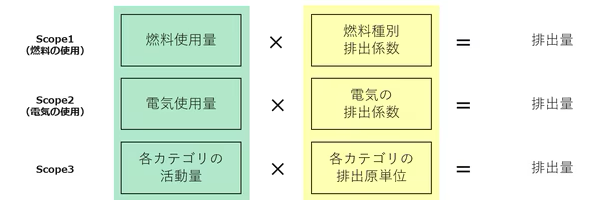
CO2 emissions are calculated using the following formula with the emission factor:
CO2 emissions = Activity level × Emission factor
What is activity level?
To calculate CO2 emissions, you need "activity level." This is the "quantity" used to determine how much CO2 is emitted as a result of an action. This includes things like electricity consumption, fuel consumption, and transportation distance. For example, if you drive 100km in a car, that 100km is your activity level.
What is an emission factor?
Next is the "emission factor." This is a numerical value that indicates how much CO2 is emitted per unit of activity. It is applied to fuels, electricity, and other raw materials. Different emission factors are set for each emission source, such as the type of fuel, energy source, means of transportation, and waste disposal method. For example, this would include the amount of CO2 emitted per liter of gasoline.
Below are some specific examples of emission factors.
- fuelCO2 emissions from the combustion of fuels such as oil, coal, and natural gas are calculated based on the type of fuel and the amount of fuel consumed (activity level). For example, the emission factor for gasoline is approximately 2.32 kg-CO2/L, meaning that burning 1 liter of gasoline will emit approximately 2.32 kg of CO2.
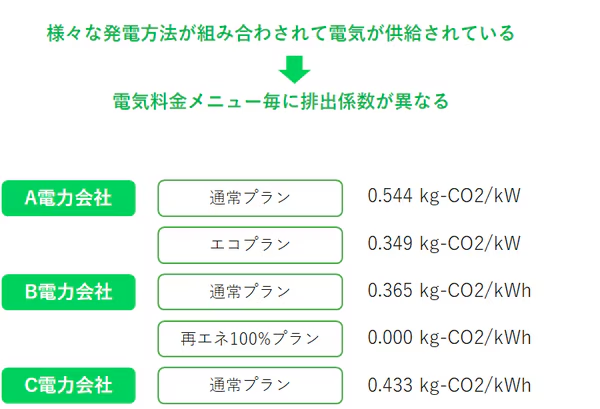
- electric powerCO2 emissions from electricity consumption are calculated based on the power source (thermal power, hydroelectric power, nuclear power, etc.) and the amount of electricity consumed (activity level). Since power sources differ from country to country and region to region, emission factors also differ depending on the electricity provider. For example, the CO₂ emission factor for retail electricity providers in Japan is 0.462 kg-CO2/kWh (FY2018) on a national average basis based on the calculation, reporting, and disclosure system*, meaning that consuming 1 kWh of electricity will emit approximately 0.426 kg of CO2.
- transportationCO2 emissions from transportation are calculated based on the mode of transport (car, train, aircraft, ship, etc.) and the distance traveled (activity level). For example, the emission factor for a passenger car (gasoline car) is approximately 0.015 kg-CO2/km, meaning that approximately 0.015 kg of CO2 is emitted for every 1 km traveled.
*Source: Ministry of the EnvironmentEvaluation results of the progress of measures to combat global warming in the electric power sector」
Emission factors can generally be accessed from databases provided by government agencies and international organizations. For example, in Japan, the Ministry of the Environment publishes an emission factor database, providing emission factors for various sources. As for international emission factor databases, there is the "2006 IPCC Guidelines (2019 Revised Edition)" provided by the IPCC (Intergovernmental Panel on Climate Change). There are also the "Inventory Database IDEA" provided by the LCA Utilization Promotion Consortium and the "ecoinvent Database" which can be used to calculate CO2 emissions overseas.
In calculating CO2 emissions, it is crucial to select the appropriate emission factor. Since emission factors can change over time due to technological advancements and shifts in energy policy, it is necessary to regularly refer to the latest data to accurately calculate CO2 emissions. Furthermore, since emission factors may exist that are specific to certain industries or regions, it is desirable to select the appropriate data depending on the situation.
Reference: Ministry of the Environment:List of calculation methods and emission factors | "Greenhouse Gas Emission Calculation, Reporting, and Publication System"
Reference column:What is the ecoinvent Database that global companies need?
Scope1 calculation method
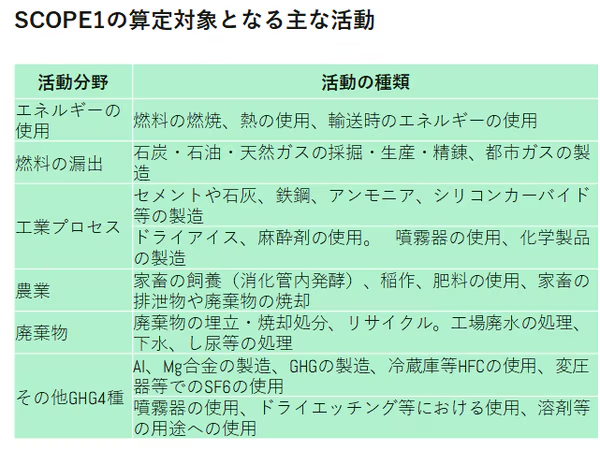
Scope 1 includes greenhouse gas (GHG) emissions from sources that an organization directly controls. This includes emissions from fuel combustion, manufacturing processes, and vehicles owned or managed by the organization.
Basic steps in calculating Scope 1 emissions
- Identifying the scope of activityFirst, identify the emission sources that the organization directly controls. This includes facilities, vehicles, and equipment that it owns or operates.
- Data collectionNext, we collect data related to each emission source. For example, in the case of fuel combustion, we collect data on the type and amount of fuel used.
- Selection of emission factorsSelect an appropriate emission factor. This emission factor is typically obtained from government agencies or reliable databases.
- calculationUsing the collected activity data and selected emission factors, we calculate GHG emissions. The basic formula is as follows:
CO2 emissions = Activity level × Emission factor
Specific example
- Fuel combustion: The amount of natural gas used in the boilers owned by the organization is measured (activity level), and the CO2 emissions are calculated by multiplying that amount by the applicable emission factor (for example, natural gas: 2.698 kg-CO2/kg).
- Manufacturing processThis involves measuring the amount of GHGs emitted during a specific manufacturing process. For example, the CO2 emissions from the cement manufacturing process are calculated by multiplying the emissions factor by the raw materials used and their quantities (activity levels).
Calculating Scope 1 emissions is a particularly important step when considering emissions reduction actions, as it relates to the emission sources that organizations can control the most. Using the latest emission factors and calculation methods will provide more accurate and reliable GHG emission data.
Scope 2 calculation method
Scope 2 includes greenhouse gas (GHG) emissions generated by indirect energy sources such as electricity, heat, steam, and cooling that an organization purchases or uses. Electricity consumption often falls into this category.
Basic steps in calculating Scope 2 emissions
- Identification of purchased and used energyIdentify the types and quantities of electricity, heat, steam, and cooling that the organization purchases or uses.
- Data collectionWe collect data related to each energy source. This is typically expressed as energy consumption (kWh, GJ, MJ, etc.).
- Selection of emission factorsSelect the emission factor corresponding to the energy source you will be using. Emission factors can often be obtained from databases provided by government agencies or research institutions.
- Calculation: Using the collected activity data and selected emission factors, we calculate GHG emissions. The basic calculation formula is as follows:
CO2 emissions = Energy consumption × Emission factor
Specific example
- electric power: Multiply the amount of electricity used by the organization (e.g., 1,000 kWh) by the corresponding emission factor (e.g., 0.5 kg-CO2/kWh) to calculate the CO2 emissions (500 kg-CO2).
- Heat and steamThe amount of heat or steam purchased by the organization (e.g., 200 GJ) is multiplied by the corresponding emission factor (for industrial steam: 0.06 kg-CO2/GJ) to calculate the CO2 emissions (12 kg-CO2).
- cold heatIn the case of cooling energy, the calculation is also done using the amount used and its emission factor. However, the emission factor for cooling energy is generally lower than that for electricity.
Points to note
Emission factors may vary depending on the energy supplier and region. In this case, using emission factors specific to the region and power company will allow for more accurate calculations.
If you purchase green energy, the emissions factor for that electricity is usually zero or very low. These special cases must also be taken into consideration in calculations.
Calculating Scope 2 emissions is crucial for understanding and reducing environmental impact, particularly electricity consumption. Using the latest emission factors and calculation methods allows for accurate GHG emission data.
Scope 3 calculation method
Scope 3 is a classification of greenhouse gas (GHG) emissions that an organization does not directly control but are caused by its business activities. This includes emissions in the supply chain, employee commutes, and product use and disposal.
Basic steps in calculating Scope 3 emissions
- Identifying categoriesScope 3 has 15 categories (such as purchase of products and services, transportation and distribution, and use and disposal of products). First, identify which categories are relevant to your organization.
- Data collectionWe collect data on activities that impact emissions for each relevant category. This data may be expressed in various units, such as volume, distance, and time.
- Selection of emission factor or emission intensitySelect the appropriate emission factor or emission intensity. This can be obtained from your organization's own data, data submitted by suppliers, industry guidelines, or public databases.
- calculationUsing the collected activity data and selected coefficients, we calculate GHG emissions.
CO2 emissions = Activity level × Emission factor (or emission intensity)
Specific example
- supply chainThe CO2 emissions from the raw materials required to manufacture a certain product are calculated using emission intensity data obtained from an emission intensity database.
- Employee commuteBased on the mode of transportation used by employees (car, train, bus, etc.) and the distance traveled, CO2 emissions are calculated using emission factors.
- Product use and disposalThe emissions are calculated based on how the product is used and disposed of by the customer. This may involve using a professional life cycle assessment (LCA).
Points to note
Because Scope 3 emissions are related to a wide variety of activities, data collection can be complex and time-consuming.
Ideally, emission data should be obtained directly from specific suppliers or partners, but if this is not possible, estimates or averages may be used.
Depending on the country, industry, or region, guidelines and tools regarding Scope 3 emissions may exist. For example, the guidelines provided by Japan's Ministry of the Environment may be helpful.
Detailed calculation and management of Scope 3 emissions are crucial for enhancing sustainability across the entire supply chain. For many organizations, Scope 3 accounts for the majority of total emissions, so reducing it leads to a significant reduction in the organization's overall environmental impact.
Reference column:What is supply chain emissions calculation?
summary
Calculating CO2 emissions is essential for businesses and individuals to understand their environmental impact and work towards reducing greenhouse gas emissions. It is important to calculate CO2 emissions using activity levels, emission factors, and emission intensity, and to understand them in detail by dividing them into Scope 1, Scope 2, and Scope 3. Furthermore, accurate CO2 emission calculations should be performed by referring to the Ministry of the Environment's guidelines and emission intensity database. Understanding CO2 emissions across the entire supply chain is also a crucial element for companies aiming for sustainable management.
booost technologies enables efficient collection of activity data and the calculation, estimation, and visualization of CO2 emissions using the latest emission factors.booost GXWe offer consulting services. If you are having trouble calculating CO2 emissions, please contact us using the information below.