
booost technologies offers "booost GX," a management system for calculating and reducing CO2 emissions, and "booost Supplier," which enables visualization and reduction of CO2 emissions in the supply chain and sharing of ESG data.
You can download detailed information here!
● Service introduction materials for "booost GX"
What is a carbon footprint (CFP)?
When considering concrete measures to reduce GHG emissions, there is the Carbon Footprint of Product (CFP). This is a method of visualizing the GHG emissions of your company's products and services. With increasing demands from business partners, many companies may be considering implementing CFP calculations.
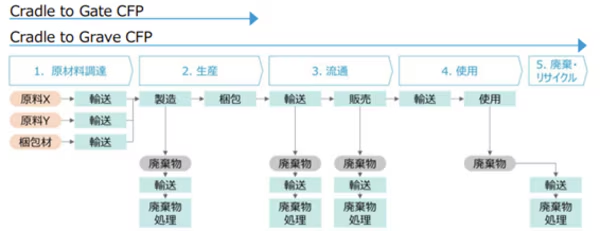
CFP calculates CO2 emissions by converting GHG emissions throughout the entire lifecycle of a product or service, from raw material procurement to disposal and recycling.
Calculation method
For calculation purposes, the "Carbon Footprint Guidelines" published by the Ministry of Economy, Trade and Industry and the Ministry of the Environment in 2023 are a useful reference. The "Practical Guide" and its explanatory materials were updated in March 2024. Let's review the calculation steps.
Examination of calculation policy
First, we consider the calculation policy. Specifically, we clarify the purpose of the calculation and its intended use after calculation. Then, we determine the rules to be referenced during the calculation, in accordance with the purpose and intended use.
▼If you would like to learn based on specific examples, please also refer to this article.
In some industries and for certain products, calculation rules are already established, so we will proceed with the calculation while referring to those rules. Otherwise, we generally refer to ISO, the GHG protocol, or the "Carbon Footprint Guidelines" when calculating.
These calculation rules and guidelines contain areas that are open to interpretation or are not explicitly stated, so companies need to establish their own calculation methods. This is one of the obstacles for companies and practitioners who are proceeding with CFP calculations.
Setting the calculation range
Next, we define the scope of the calculation. We consider whether the scope should be limited to the Cradle to Gate phase, from raw material procurement to production and shipment, or to the Cradle to Grave phase, which includes the entire lifecycle from raw material procurement to disposal and recycling.
We will also consider cutoff criteria (the amount of substance or energy to be excluded from the calculation, or the requirements and criteria for exclusion related to a unit process or product system).
CFP calculation
After determining the calculation policy and scope, we proceed with calculating the GHG emissions (and removal/absorption amounts) for each process. The CFP can be calculated by summing the emissions from each process. We collect activity amounts such as the amount of raw materials procured and the amount of electricity consumed during production, determine emission factors corresponding to each activity amount, and calculate emissions by multiplying them.
For activity levels, collecting primary data is desirable, but if the data is complex, it is possible to set up scenarios to address the issue. For emission factors, collecting primary data is desirable, but if that is difficult, secondary data can be used.
<Reference>
Primary data refers to quantified values of processes, activities, and emission factors derived from calculations based on data actually acquired within the product system. To obtain primary data on emissions upstream in the supply chain, it is necessary to receive emission data from suppliers.
Secondary data refers to data that does not meet the requirements of primary data. Examples include data from external databases or research papers on the same product category or process, and proxy data (extrapolation, scaling up, customization).
Verification and Reporting
Finally, we will review the data collection methods and calculation logic, and organize the calculation results. If secondary data was used, we will include an explanation of its use.
Thus, in calculating emissions, it is necessary to understand the content of the rules being referenced, grasp the raw materials and production processes of your own products, and investigate and identify the required activity levels and emission factors for each process.
Furthermore, it is important not to simply calculate the CFP figure and be done with it, but to continuously monitor it as one of the indicators. The information obtained in the process of calculating CFP should be put into action as emission reduction measures, and the results should be monitored again by calculating CFP.
Benefits of CFP calculation
Despite the hurdles involved in calculation, interest in CFP calculation continues to grow.
The advantages of calculating CFP include the ability to visualize the emissions from your own products and services and the effectiveness of reduction activities, as well as the ability to differentiate yourself from competitors by starting these efforts before being requested by your business partners.
This allows you to understand which processes in your product supply chain should be prioritized for emission reduction, enabling you to consider effective emission reduction measures and monitor their impact.
There is a growing market demand for low-carbon products and services, and the visualization of emissions using CFP (Carbon Fiber Product) is necessary as an indicator to measure this demand. In the future, CFP labeling may influence purchasing behavior not only among consumers but also through the green procurement policies of governments and companies.
▼Click here for interview articles on CFP calculation case studies
We asked for a detailed explanation of the advantages and disadvantages of the calculation method.
Trends surrounding CFP
Amidst the trend towards disclosing emissions across the entire supply chain, buyers are increasingly requesting CFPs (Certified Financial Statements) for products and services supplied by their suppliers.
Global companies, in particular, are making progress in procuring decarbonized and low-carbon products. In the United States, public procurement utilizing CFPs is being implemented, and within the EU, regulations concerning CFPs, such as CBAM and battery regulations, have also been introduced.
summary
We recommend starting the calculation of your carbon footprint before your business partners request it. In Japan, keep a close eye on developments based on the "Carbon Footprint Guidelines."
CFP has the potential to influence purchasing behavior, including that of consumers and in public procurement, and the following initiatives are particularly anticipated:
- Development of a domestic CFP (Certified Financial Planner) environment, etc.
The development of product-specific calculation rules and efforts to expand the use of primary data are being considered. - Building a green procurement system
Criteria and calculation methods for determining whether a product qualifies as green in public procurement are currently under consideration. - Support for initiatives centered on small and medium-sized enterprises
To lower the hurdles for calculation, the provision of widely usable secondary databases is being considered.
*If you would like to learn more about life cycle assessment, please refer to this article as well.
Source: Ministry of Economy, Trade and Industry, Ministry of the Environment, "Carbon Footprint Guidelines" (March 2023)
Part 1 CFP20230703_001.pdf (env.go.jp)
Part 2 CFP20230703_002.pdf (env.go.jp)
Microsoft PowerPoint – 230912 [Ministry of Economy, Trade and Industry] Trends in CFP Policy.pptx (meti.go.jp)